

Every trade has a price tag, even when nobody sends you an invoice. In forex, most of that price is built into the quote you see, some of it is charged when you hold a position overnight, and some may appear as a commission on your statement. None of it is complicated once you know where to look.
This guide explains forex trading costs in plain English: what each one is, when it applies, and how to check it in MetaTrader 5 before you place a trade.
Key takeaways
• The spread is the gap between the buy and sell price. You pay it on every trade, the moment you open it.
• A commission is a separate charge per lot, usually paired with tighter spreads.
• A swap is an overnight financing adjustment. It only applies to positions still open at the daily rollover, and it can be a charge or a credit.
• Costs are calculated on your full position size, not on the margin you put up.
• MT5 shows the spread, swap rates, and triple-swap day for every instrument, so you can check them first.
What does it cost to trade forex?
Forex trading costs come in three main forms: the spread, which is the difference between the buy and sell price; a commission, which some accounts charge per lot traded; and the swap, an overnight financing charge or credit on positions held past the daily rollover. Account-level fees, such as for withdrawals or currency conversion, can apply on top.
The rest of this guide takes each one in turn.
The spread: the cost built into every price
Bid, ask, and the gap between them
Every forex quote has two prices. The bid is the price at which you can sell. The ask is the price at which you can buy. The ask is always slightly higher, and the difference between the two is the spread.
Say EUR/USD is quoted at 1.08500 / 1.08510. The gap is 0.00010, which is 1.0 pip. Because you buy at the higher price and sell at the lower one, every new position starts slightly negative. If you opened a trade and closed it straight away with prices unchanged, you would lose exactly the spread. The market has to move in your favour by at least the spread before the trade breaks even.
Turning pips into money
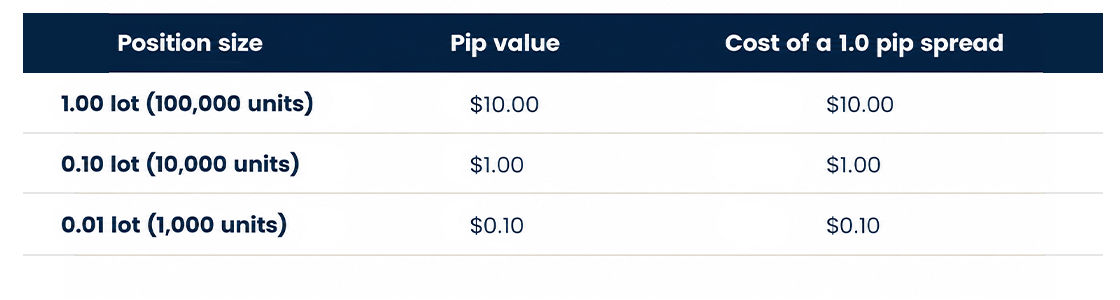
The formula is simple: spread cost = spread in pips x pip value x number of lots. For EUR/USD and other pairs quoted against the US dollar, one pip on one standard lot (100,000 units) is worth $10. A 1.0 pip spread therefore costs:
For pairs where the US dollar is not the second currency, such as USD/JPY or EUR/GBP, the pip value moves with the exchange rate. MT5 does the conversion into your account currency for you, so the profit and loss figure on screen is always in the currency you hold.
Why spreads move
Most spreads are variable. They are tightest when the market is busiest and widen when fewer buyers and sellers are active, typically:
• around major economic data releases and central bank decisions
• during the daily rollover period, when liquidity providers reset their books
• in quieter hours, on public holidays and at the weekly open
• on less-traded and exotic currency pairs, which carry wider spreads in general
This matters in two practical ways. A spread that is a small fraction of a trade you plan to hold for days can be a large share of a scalp aiming for a few pips. And a stop-loss placed very close to the price can be triggered by a briefly wider spread even if the chart barely moves, because MT5 charts show the bid price while sell positions close at the ask.
Pips and points in MT5
MT5 shows spreads in points, not pips. On pairs quoted to five decimal places (and three for JPY pairs), 10 points = 1 pip, so a spread of 12 in Market Watch means 1.2 pips. To see it, right-click Market Watch, choose Columns, and tick Spread. For gold, oil, and indices, the size of a point is set in each instrument’s contract specification, so check it there rather than assume.
Commission: the visible charge
Some accounts charge a commission: a fixed amount per lot traded, shown separately on your statement. In return, the spread on those accounts is usually much tighter.
Commission is normally quoted per lot per side. Opening a trade is one side and closing it is the other, so a complete trade, known as a round turn, costs twice the quoted figure.
Spread-only or commission: which is cheaper?
Compare the all-in cost of a round trip, not the headline spread. Here is the method with illustrative numbers:
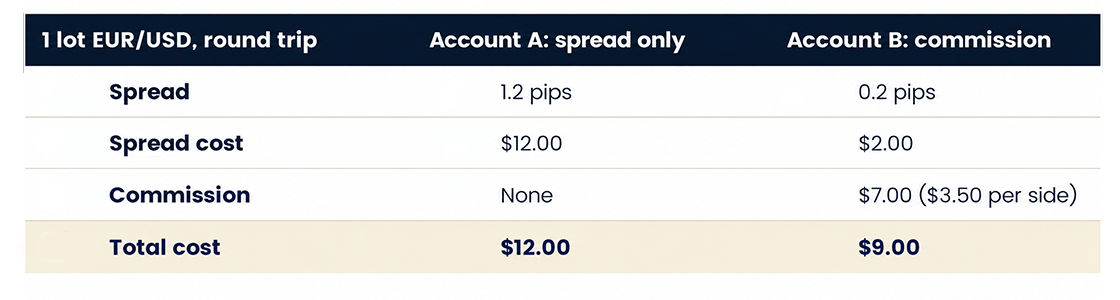
Neither model is better for everyone. Commission accounts tend to suit active traders and larger sizes, where tight spreads add up over many trades. A spread-only account is simpler to read, because the whole cost sits in one number. Arabian Markets offers four account types, Basic, Standard, Platinum and Premium, and the Accounts page sets out the pricing of each so you can run this comparison yourself.
Swaps: the cost of holding overnight
What a swap is
When you trade a currency pair, you are in effect borrowing one currency to hold the other, and each currency carries its own interest rate. If your position is still open at the daily rollover, it is adjusted for the difference between the two rates, plus the broker’s financing charge. That adjustment is the swap, also called rollover or overnight financing. Three things follow from it:
• Close before the rollover, and there is no swap. Traders who are flat by the end of each day never pay it.
• A swap can be positive or negative. Holding the higher-yielding currency against a lower-yielding one can earn a small credit, although the financing charge often makes it a cost in both directions.
• Long and short swaps differ on the same instrument, because buyers and sellers sit on opposite sides of the rate difference.
CFDs on indices, metals and commodities carry swaps too. There they reflect the cost of financing the position rather than a gap between two currencies.
Why Wednesday costs three times as much
Spot forex trades settle two business days after they are made. A position held through Wednesday’s rollover is rolled to a Friday settlement and then on to Monday, so it carries interest for the weekend as well. To account for this, brokers apply three days of swap on Wednesday night, and holding through Friday night carries only one. Some CFDs use a different triple-swap day, often Friday, and MT5 shows the correct day for every instrument.
Reading swap rates in MT5
Right-click the instrument in Market Watch and choose Specification. Four lines tell you what you need:
• Swap type: how the rate is expressed, most often in points
• Swap long: the rate applied to buy positions
• Swap short: the rate applied to sell positions
• 3-day swap: the day the triple charge applies
A negative number is a charge and a positive number is a credit. On a five-digit EUR/USD quote, one point on one standard lot is worth $1, so a swap long of -5.0 points costs about $5 per lot for each night held. Swap rates are updated as interest rates change, so check them close to the time you trade.
Swap-free accounts
Some traders cannot pay or receive interest, often for religious reasons. Swap-free accounts, sometimes called Islamic accounts, remove the overnight swap. They are not always free of holding costs: brokers commonly set other terms, such as an administration fee after a set number of days or a limit on how long positions can stay open. If you need a swap-free arrangement, ask the Arabian Markets client desk about eligibility and terms before you open positions.
Other fees worth checking
These sit at account level rather than on each trade. Not every broker charges all of them, but each one is worth checking once in the terms of business:
• deposit and withdrawal fees, plus any charges from your own bank or payment provider
• currency conversion, when you deposit in a different currency from your account currency
• inactivity fees on accounts left unused
• charges for extras, such as a VPS for running automated strategies
Two more items are not fees but still affect your result. Slippage happens in fast markets, when an order fills at a slightly different price from the one requested; it can work for you or against you. Leverage adds no fee of its own, but every cost above is calculated on the full position, not the margin. A one-lot EUR/USD trade costs the same in spread whether your account uses a little margin or a lot.
Putting it together: one trade, every cost
Suppose you buy 1 lot of EUR/USD on a commission account on Monday and close it on Thursday, before that night’s rollover. Using illustrative figures:
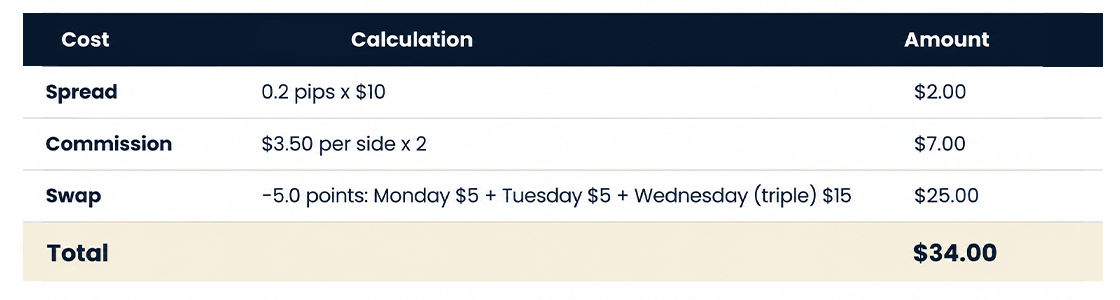
Here the swap is the highest single cost, bigger than the spread and commission combined. That is the pattern to remember: for short-term trades the spread usually dominates, while for trades held for days or weeks the swap often does. Knowing which applies to your style tells you which number to compare first.
Your pre-trade cost checklist
1. Check the live spread in Market Watch and compare it with your target and stop distance.
2. Know whether your account charges commission, and double it for a round turn.
3. If you might hold overnight, open Specification and read the swap for your direction.
4. Note the triple-swap day if you will hold through the middle of the week.
5. Give stops extra room around the rollover and major news, when spreads widen.
6. Read your account’s fee schedule for deposits, withdrawals, and conversions, so nothing on your statement surprises you.
Trading costs do not decide whether a single trade wins, but across hundreds of trades they decide how much of your edge you keep. Every number in this guide is visible before you click buy or sell. Make checking them a habit, and compare account types on our Accounts page to find the pricing that fits the way you trade.
Frequently asked questions
What is the difference between a spread and a commission?
The spread is built into the price: it is the gap between the buy and sell quote. A commission is a separate, fixed charge per lot. Commission accounts usually have tighter spreads, so compare the total cost of a round trip.
Why is a swap charged three times on Wednesday?
Spot forex settles two business days after the trade. A position held through Wednesday’s rollover carries the weekend’s interest, so three days of swap are applied at once. Some CFDs use a different day, as shown in MT5.
Can a swap be positive?
Yes. If you hold a currency with a higher interest rate against one with a lower rate, the swap can be a credit. The broker’s financing charge often reduces it or turns it into a cost.
Do I pay a swap if I close my trade the same day?
No. Swap only applies to positions that are still open at the daily rollover.
Where can I see the spread and swap in MT5?
The live spread appears in the Spread column of Market Watch, in points. Swap rates and the triple-swap day are in the instrument’s Specification window.
Is the lowest spread always the cheapest option?
Not always. Add any commission, and if you hold positions overnight, the swap. The cheapest account is the one with the lowest total cost for the way you trade.