

Ask traders how big their next position should be, and many will answer with a feeling: it looks about right, or it is what they used last time. Forex position sizing replaces that feeling with a calculation you make before every trade. It needs no maths degree: three numbers, one division, and an allowance for trading costs.
This guide shows how to turn a loss you have chosen into a trade size, using the contract data in your MetaTrader 5 platform.
KEY TAKEAWAYS
Decide the most you are prepared to lose on a trade in money before you think about lots
Position size comes from three numbers: your risk amount, your stop-loss distance, and the value of one pip.
A wider stop-loss needs a smaller position. Leverage changes the margin you put up, not the loss per pip.
Your result also reflects spread, commission, slippage, and swaps, not just the distance to your stop-loss.
If a loss would change your next decision, the position was too big.
What position sizing actually means
Position sizing is choosing a trade’s volume, in lots, so that the loss at your stop-loss is an amount you set in advance. It is the part of a trade that is largely in your hands. You cannot control where the market goes, but you can decide how much a wrong idea is allowed to cost.
Much of the attention in trading goes to the entry: which pair, which direction, which signal. The size is often decided in a second, by habit. Yet two traders with the same entry and the same stop-loss will lose very different amounts if one trades five times the size of the other.
Start with the money, not the lots
A lot size on its own tells you very little. The same position can be cautious on one trade and reckless on another, depending on where the stop-loss sits. So turn the question around. Instead of asking “how many lots should I trade?”, ask “if this trade is wrong, how much money am I prepared to lose?”. That figure is your risk amount, and everything else follows from it.
How to choose your risk amount
There is no universal figure, because it depends on your account, your finances and your experience. A practical test is to imagine a run of losing trades, which every trader meets sooner or later. Ask yourself:
Could I take ten losses of this size in a row and still follow my plan calmly?
Would the total affect my bills, savings, or plans?
Would I be tempted to trade bigger to win it back?
If you hesitate over the first question, or answer yes to the second or third, the amount is too high. Start smaller than feels necessary, and only with money you can afford to lose. Change it only as a planned decision, not after a win or a loss. Write the figure down and use it consistently, so each trade is sized by a decision you made calmly, not in the moment. Our post on risk, explained without the scare tactics, covers the habits that support this.
The three numbers you need
Your risk amount: the money you are prepared to lose on this trade, in your account currency.
Your stop-loss distance in pips: the gap between your actual entry price and your stop-loss. On a buy, you enter at the ask, but the stop-loss is triggered by the bid, so the spread is part of that distance; on a sell, the reverse applies. Place the stop where your trade idea is proven wrong, not where the loss feels comfortable.
The pip value per lot: how much one pip is worth on one lot of that instrument, in your account currency. MT5 does not display it directly; the section on finding it in MT5 shows how to get it.
Put them together, and the whole calculation is one line:
FORMULA:-
Position size (lots) = risk amount ÷ (stop-loss distance in pips × pip value per lot).
If your account charges commission, add the total commission per lot, for opening and closing, to the figure in brackets.
Working out a position size, step by step
Here is an illustrative example. The figures are chosen to keep the arithmetic simple and are not a recommendation of how much to risk.
Your account is in US dollars, and you want to buy EUR/USD. You have decided your risk amount is $50 and your stop-loss sits 25 pips below your entry. For EUR/USD in a US dollar account, one pip on one standard lot (a contract size of 100,000 units) is worth $10. The same holds for other pairs with the US dollar as the quote currency, provided the contract size is also 100,000. Confirm it in the MT5 Specification window, covered below.
Loss per lot if the stop is hit: 25 pips × $10 = $250.
Position size: $50 ÷ $250 = 0.2 lots.
Check it: 0.2 lots × 25 pips × $10 = $50, your risk amount before commission and slippage.
If the result is not a size the platform accepts, round down to the nearest volume step, never up. If even the minimum volume would lose more than your risk amount at that stop, the trade does not fit your plan. Skip it rather than size up.
The $50 is the loss at your stop-loss price. Your account will also reflect the costs of the trade:
Spread: you buy at the ask and sell at the bid. Measure your stop distance from your actual fill price, and the spread is already inside it.
Commission: if your account charges it, add it to the bracketed figure in the formula above. Your account terms show how it is applied.
Slippage: a stop-loss becomes a market order once it is triggered, so it fills at the next available price. In fast markets, this can be worse than your stop.
Swaps: a position held past the daily rollover is charged or credited a swap, depending on direction and instrument. It is small on a short trade and can add up on a longer one.
Wider stop, smaller position
The stop-loss comes first because it decides the size, not the other way round. Keep the same $50 risk amount and watch what happens as the stop moves:
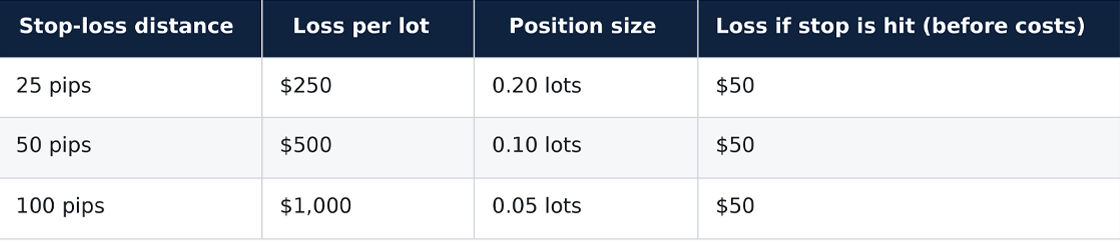
The loss stays the same; only the size changes. This is also why moving a stop-loss further away to “give the trade room” without reducing the position quietly increases your risk.
Finding the pip value in MT5
For pairs quoted in your account currency, the pip value follows from the contract size. For other instruments, it varies. On yen pairs and crosses, the pip value in your account currency moves with the exchange rate. Gold, indices, and oil are usually measured in price points rather than pips. MT5 gives you the numbers:
In Market Watch, right-click the instrument and open Specification. Note the contract size, the tick size, and the tick value. The tick value is the profit or loss, in your account currency, from a one-tick move on one lot.
Pip value per lot = tick value × (pip size ÷ tick size). On a pair quoted to five decimal places, the tick size is 0.00001 and a pip is 0.0001, so one pip is ten ticks. If the symbol is quoted to four decimal places, a pip is one tick. Check the quoted digits in the specification rather than assuming.
For gold, indices, and oil, skip the pip: loss per lot = stop distance in price × (tick value ÷ tick size).
On pairs not quoted in your account currency, the tick value depends on the current exchange rate, so check it again before each trade.
As a cross-check, open the smallest trade the platform allows on a demo account, move one pip in the profit column, and scale that figure up to one lot. Demo spreads and fills can differ from live trading, so use it to verify the arithmetic, not your costs.
The Specification window also lists the minimum volume, the volume step you round down to, and the swap rates for long and short positions.
Leverage changes the margin, not the risk per pip
Leverage decides how much margin you need to open a position. It does not change how much you gain or lose per pip: a 0.2-lot EUR/USD position moves by the same amount per pip, about $2 in a US dollar account, whatever leverage the account uses. Higher leverage makes it possible to open a position that is far too large for the account. It also leaves less free margin to absorb a move against you, so a position can be closed by a margin call or stop-out before your stop-loss is reached. Size from your risk amount first, then check that you have enough free margin. Our guide to forex leverage explains margin in more detail.
Five signs a position is too big
You chose the size based on how much you hoped to make, not how much you could lose
You are watching every tick, or the trade is affecting your sleep.
You moved the stop-loss further away without making the position smaller.
You hold several trades that are really the same idea, such as buying EUR/USD and GBP/USD together against the dollar, so your combined risk is larger than it looks.
One loss would make you want to trade again straight away to win it back.
A 30-second check before every trade
Where is my stop-loss, and why there?
What is my risk amount for this trade, after allowing for spread and commission?
What is one pip worth on one lot of this instrument, in my account currency?
Divide, then round down to the volume step.
Do my open trades, added together, stay within what I am prepared to lose?
Is there enough free margin left after this trade?
Add these six lines to your trading journal. Our guide to building a trading routine shows where a pre-trade check fits into the week.
The short version
Decide the money first, place the stop-loss where the idea is wrong, divide, and round down. That is forex position sizing without the mathematics degree. Practise it on a demo account in MT5 until it takes less than a minute, remembering that live spreads and fills can differ. If anything about your account or the platform is unclear, contact our team.