

The forex market never really sleeps during the week, but it is not equally busy at every hour. A pair that barely moves at one time of day can move sharply a few hours later, with tighter spreads and far more activity. The difference usually comes down to which financial centers are open.
This guide explains forex trading sessions: when each one runs, what each is like, why the overlaps matter most, and how to choose a trading window that fits your own day.
Key takeaways
• Forex trades around the clock from Monday morning in Asia to Friday evening in New York, passing through four main sessions.
• London is the busiest single session, and the London-New York overlap is usually the most active part of the day.
• Spreads tend to be tightest when activity is highest and widest when it is low, such as around the daily rollover.
• Session times shift by an hour when clocks change in the UK, the US and Australia.
• The best session for you is the one you can trade consistently, not the one with the most movement.
What are forex trading sessions?
Forex trading sessions are the periods when the main financial centres are open for business: Sydney, Tokyo, London and New York. Because these centers sit in different time zones, the market runs almost 24 hours a day on weekdays, with activity rising and falling as each session opens, overlaps and closes.
Why forex trades around the clock
Unlike a stock exchange, the forex market has no single central venue. Currencies are traded between banks, institutions, companies and brokers across the world. As the business day ends in one region, it begins in another, so trading passes from Asia to Europe to North America and back again.
That is why you can place a trade on EUR/USD at almost any hour from Monday to Friday. Being able to trade, though, is not the same as the market being active. Liquidity, meaning how much buying and selling is going on, follows the sessions closely.
The four main sessions
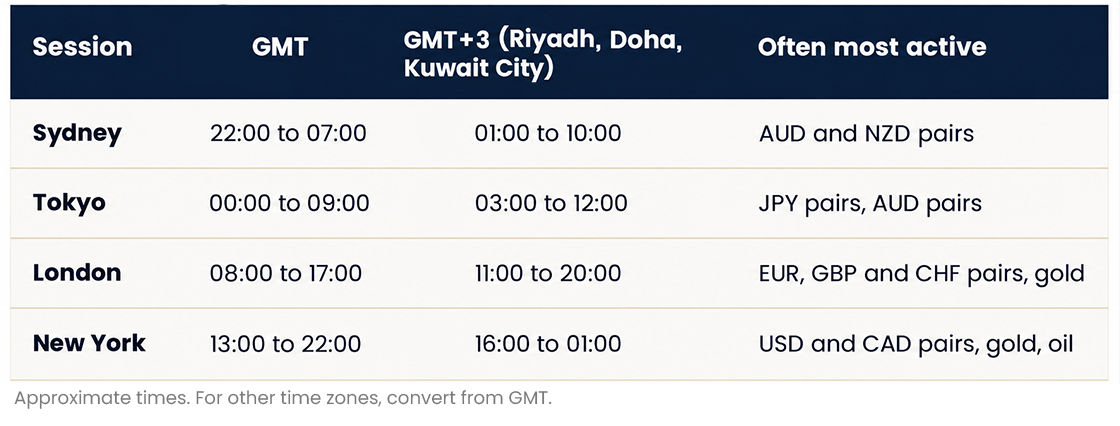
These are approximate times for November to March. Different sources draw the edges slightly differently, so treat them as a guide rather than exact bells:
A note on clock changes
From late March to late October, the UK and US move their clocks forward, so the London and New York sessions start an hour earlier in GMT terms. Tokyo does not change its clocks. Sydney changes in the opposite direction, because its summer falls in our winter. For a week or two each spring and autumn, the UK and US change on different dates, so the gap between London and New York briefly shifts as well.
When the week opens and closes
The trading week starts on Sunday evening GMT as Sydney opens, which is early Monday morning in GMT+3, and ends on Friday evening when New York closes. Your platform’s exact hours can vary by instrument. In MetaTrader 5, right-click a symbol in Market Watch and choose Specification to see its trading sessions.
What each session is like
Sydney and Tokyo: the Asian session
The Asian session is usually the calmest stretch of the day for major European and US pairs. Activity centres on the Japanese yen and the Australian and New Zealand dollars, and on data from Japan, Australia and China. Ranges are often narrower, which some traders prefer, and others find too slow.
London
London handles the largest share of global currency trading, and its open often brings a clear rise in activity. The euro, pound and Swiss franc are especially active, and many of the day’s larger moves begin here. Key UK and eurozone data are released during this session.
New York
New York brings US data and US market participants. Many major US releases come out at 8:30 New York time, which is 13:30 GMT in winter, and the first half of the session overlaps with London. Activity usually fades in the afternoon, after London closes.
The overlaps: when activity peaks
The busiest periods tend to be when two centers are open at the same time:
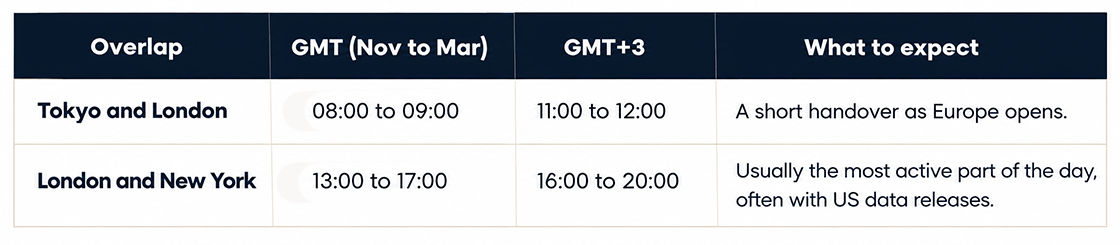
Higher activity cuts both ways. Prices can move further and faster during the overlap, which creates opportunities, but it also means positions need sizing with that movement in mind. Our guide to leverage explains how position size decides how much a move affects your account.
Why the session matters for your trading
• Spreads. When more buyers and sellers are active, spreads tend to be tighter. In quiet hours, they often widen. Our guide to spreads, swaps and fees explains how this affects your costs.
• Movement. A strategy that needs price to move can struggle in a quiet session, while one built for narrow ranges can struggle in a busy one.
• News. Scheduled data and central bank decisions arrive at set times, usually inside their home session. Know what is due before your window opens.
• The daily rollover. Around 17:00 New York time, which is 22:00 GMT in winter, the trading day rolls over. Liquidity is thin, and spreads often widen for a short period, and positions held through it carry a swap.
• The weekly open. Prices can open on Monday at a different level from Friday’s close if news broke over the weekend. This is known as a gap.
Matching a session to your day
There is no single best session. The right one is the session you can trade regularly, with a clear head, around your other commitments.
• After a working day in GMT+3: the London-New York overlap falls between about 16:00 and 20:00, which suits many people with daytime jobs.
• Early risers: the London open, around 11:00 in GMT+3, is a good fit for those with free late mornings.
• Night owls: the Asian session runs through the night in GMT+3, and suits JPY and AUD pairs, but late-night trading can cost sleep, so be honest about whether you can keep it up.
Once you have chosen a window, keep it fixed for long enough to judge. Trading the same session week after week makes your results comparable, and your trading statement becomes far easier to learn from.
Finding your trading window
1. List the hours you are genuinely free and alert on most weekdays.
2. Match them against the sessions table, adjusting for your time zone and the time of year.
3. Choose the markets that are most active in that window.
4. Check the economic calendar for releases due during your window.
5. Keep the window fixed for at least a month before you judge it.
Understanding forex trading sessions will not tell you which way a market will move. What it does is help you trade when conditions suit your approach, avoid the quietest and most expensive hours, and build a schedule you can keep.