


Most traders do not struggle for lack of effort. They struggle because their effort comes in bursts: long nights at the screen after a good week, then nothing for days after a bad one. The results are hard to learn from, because no two weeks were traded the same way.
A trading routine fixes that. This guide explains why consistency beats intensity, the building blocks of a routine that fits around a working life, and a simple weekly rhythm you can try and adjust.
Key takeaways
• A routine turns trading from a series of reactions into a repeatable process you can measure and improve.
• More screen time and more trades usually mean more costs and more mistakes, not better results.
• The core pieces are a short written plan, a fixed preparation slot, a defined trading window, a journal, and a weekly review.
• A good routine fits your life. If you cannot keep it on a busy week, it is too big.
• Judge the routine by whether you followed it, not by one week’s profit or loss
What is a trading routine?
A trading routine is a fixed set of habits that shape how and when you trade: how you prepare, when you trade, how you record each trade, and how you review your results. Its purpose is to make your decisions consistent enough to measure, so you can see what works and improve it.
Why consistency beats intensity
Intensity feels productive. Watching every tick, taking every setup, and staying up for every release looks like commitment. In practice, it tends to produce the opposite of what traders want:
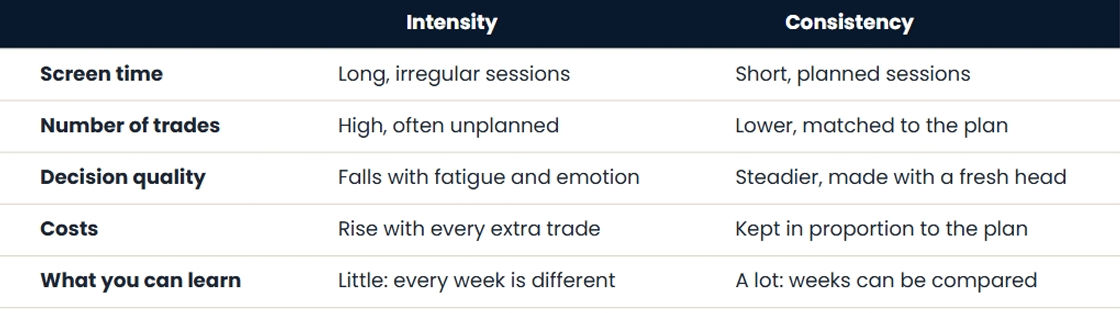
Every extra trade carries trading costs, and tired decisions are rarely the good ones. The bigger problem is that intense, irregular trading produces data you cannot use. If you change your hours, markets, and size every week, a good or bad month tells you nothing about your method. A consistent routine makes your results readable.
The building blocks of a routine
A short written plan
One page is enough. Write down which markets you trade, which sessions, what a valid setup looks like, the most you will risk on a single trade, and the most trades you will take in a day. Decisions made calmly in advance are easier to follow than ones made in the moment. Risk per trade is set through position size, so decide that here too.
A fixed preparation slot
Choose the same short window each trading day to check the economic calendar, review your markets, and mark the levels that matter. Preparation that happens at the same time becomes automatic; preparation that happens “when there is time” tends not to happen.
A trading window
Decide when you trade, and when you do not. A defined window protects you from chasing moves late at night or trading out of boredom, and it lets you plan the rest of your day around it.
A journal
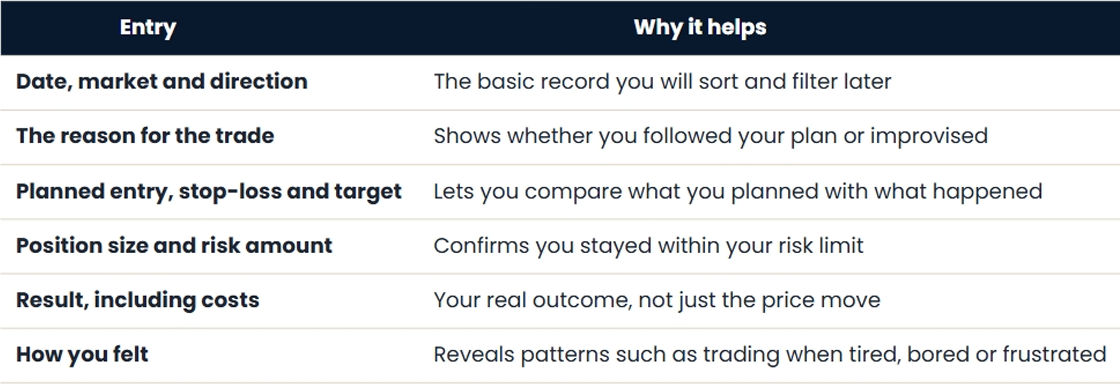
Record every trade with the reason you took it, not just the result. The journal is what turns a routine into learning.
A weekly review
Once a week, look back over your journal and your account statement. Our guide on how to read a trading statement explains which numbers are worth your attention.
Time off
Rest days are part of the routine, not a break from it. Stepping away regularly keeps your judgement fresh and stops trading from crowding out everything else.
Before, during and after: the daily shape
Each trading day can follow the same three-part shape, whatever its length:
• Before: a short preparation slot. Check the calendar, review your markets, and decide what would make you trade today, and what would not.
• During: trade only inside your window and only the setups in your plan. If nothing qualifies, no trade is a valid result.
• After: close the platform, complete your journal while the trades are fresh, and note anything to look at in the weekly review.
A simple weekly rhythm worth trying
This is a starting point, not a rule. Adjust the days and the length of each step to your schedule:
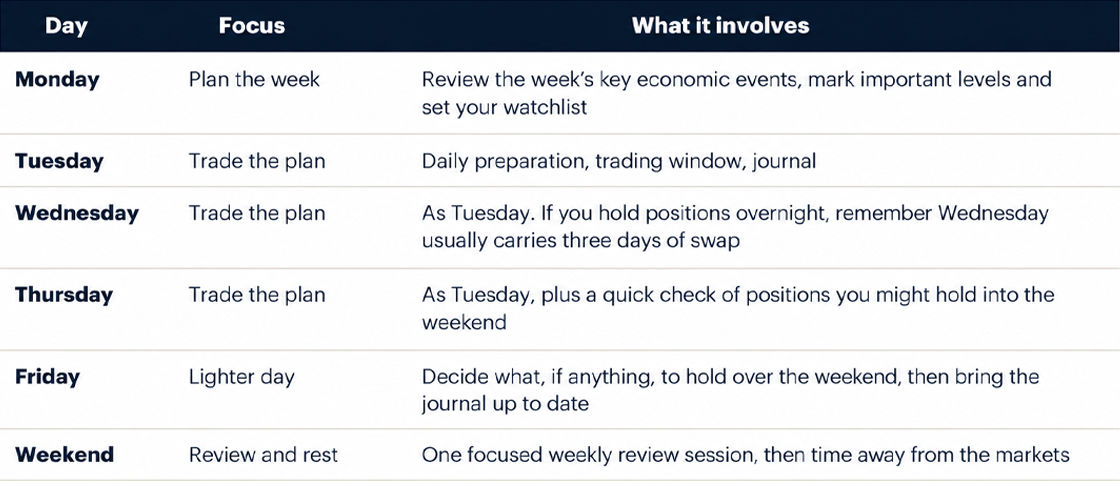
Monday preparation can start with a list of the week’s main data releases and central bank events. Arabian Markets publishes a “Key events this week” post on its social channels every Monday for exactly this.
What to record in a trading journal
Keeping it sustainable
• Start smaller than you think. A 20-minute routine you keep beats a two-hour routine you abandon.
• Fit it around your life. Work, family, and other commitments come first; the routine should slot into the genuinely free time.
• Have a minimum version. On busy weeks, the weekly review alone keeps the habit alive.
• Set rules for when not to trade: when you are tired or upset, straight after a large loss, or ahead of major news you have not prepared for.
• Measure the process. Track how often you followed your routine, not just your profit or loss.
• Change it monthly, not daily. Give each version enough time to show whether it works.
Signs your routine is too intense
Watch for these, and scale back if you notice several:
• trading outside your planned window, or taking trades that are not in your plan
• taking more trades after a loss to “win it back”
• skipping the journal or the weekly review because there is no time
• losing sleep over open positions
• trading costs rising faster than your results.
A sustainable routine will not make every week profitable, and nothing can. What it does is make your trading deliberate, measurable, and easier to improve, week after week. Start with one piece, such as the weekly review, and build from there.