
Before you send money to any broker, one question matters more than spreads, platforms, or bonuses: is this firm who it says it is, and is it licensed to do what it offers? Websites, adverts and social media posts can say anything. A regulator's public register cannot be edited by the broker.
This guide shows how to verify a forex broker in about ten minutes, step by step, using public registers only. You will not need to read a single piece of marketing material, and the same method works for any broker, including us.
Key takeaways
Verifying a broker means checking its licence on the regulator's own register, not on the broker's website.
Search by licence number and legal entity name, then check the status and permitted activities.
Match the website domain, address, and phone number with the register. A mismatch is the classic sign of a clone firm.
Check warning lists, including the regulator's alerts and IOSCO I-SCAN, before you deposit.
A licence tells you who supervises the firm. It does not protect you from trading losses.
What does it mean to verify a broker?
Verifying a broker means confirming, from independent public sources, that the company is a real legal entity, holds an active licence from a genuine regulator, is permitted to offer the services it sells, and is the same company that will hold your account. The regulator's public register is the main source, because the broker cannot change what it says.
Before you start: use registers, not marketing
The only things you need from the broker are its claims: the legal entity name, licence number, and regulator. Everything else you check independently. Three habits make the check reliable:
Type the regulator's web address yourself or find it through a search engine. Do not click links on the broker's site, which could lead to a fake register.
Ignore badges and logos. A regulator's logo on a website proves nothing; anyone can copy an image.
Write down what you find. A note of the entity name, licence number, and status is useful later, for example, when you check the company name on your first trading statement.
The ten-minute check at a glance
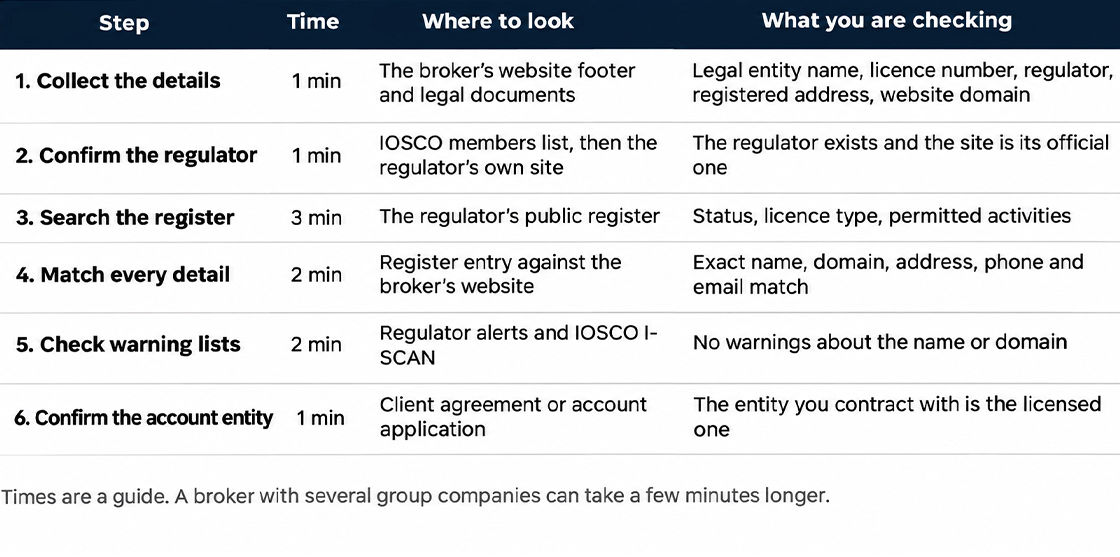
The ten-minute check, step by step
Step 1: Collect the broker's details (1 minute)
Scroll to the footer of the broker's website, or open its legal documents page. Licensed firms normally state their full legal entity name, the regulator, the licence number, and the registered address there. Note each one exactly as written. If you cannot find a licence number at all, that is already an answer.
Step 2: Confirm the regulator is real (1 minute)
Fake regulators exist, complete with professional-looking websites and registers. Check that the regulator is a recognised authority, for example by finding it in the membership list of the International Organization of Securities Commissions (IOSCO), then reach its official website independently.
Step 3: Search the public register (3 minutes)
On the regulator's website, find the public register, sometimes called a register of licensees, authorised firms, or licensed entities. Search by licence number first, then by name. Check three things:
Status: active, suspended, revoked, expired, or surrendered
Licence type and permitted activities: whether they cover dealing in forex and CFDs, not only advice or unrelated business
Entity name: an exact match, including "Ltd", "LLC", or similar
Step 4: Match every detail (2 minutes)
Compare the register entry with the website you are actually on: the domain, registered address, phone number, and email. Many registers list the firm's authorised websites or trading names. This is where clone firms are caught. A clone firm copies the name or licence number of a genuine company, so the register entry looks perfect, but the domain, phone number or email does not match. If in doubt, contact the firm using the details on the register, not those on the website.
Step 5: Check the warning lists (2 minutes)
Regulators publish alerts about unauthorised firms and known clones. Search the regulator's own warning list for the broker's name and domain, then search IOSCO I-SCAN, which gathers investor alerts from regulators worldwide in one place. In the UAE, the SCA, DFSA and FSRA all publish alerts. A single warning is enough to stop.
Step 6: Confirm which entity holds your account (1 minute)
Many brokers belong to groups with several companies in different countries. Open the client agreement or account application and check which entity you would contract with. That entity, not the group's best-known one, is the one that must appear on the register. Its regulator is the one whose rules apply to your account.
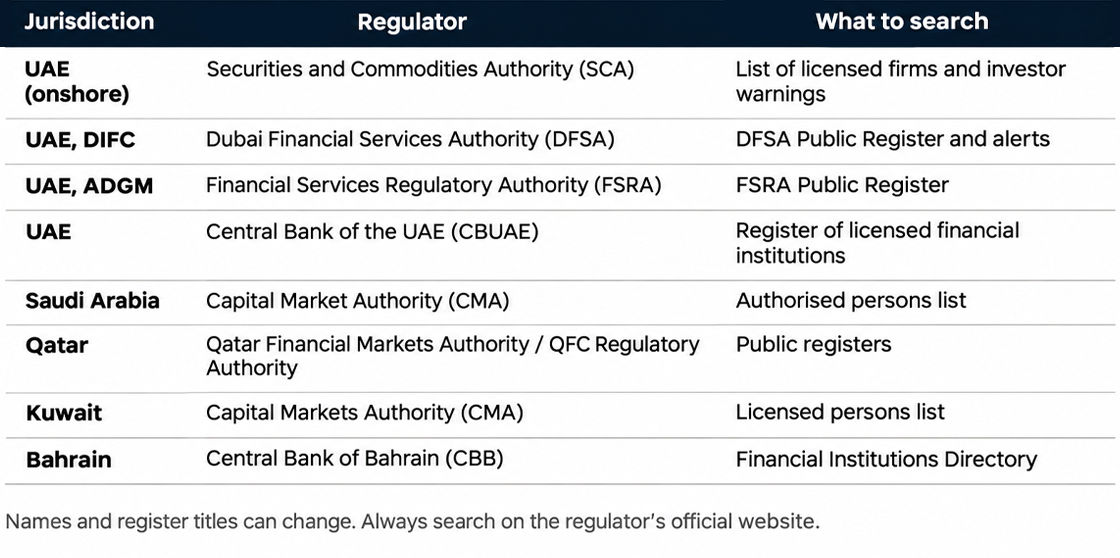
Regulators UAE and GCC traders should know
Every regulator below publishes a register or list of licensed firms on its official website:
What a licence tells you, and what it does not
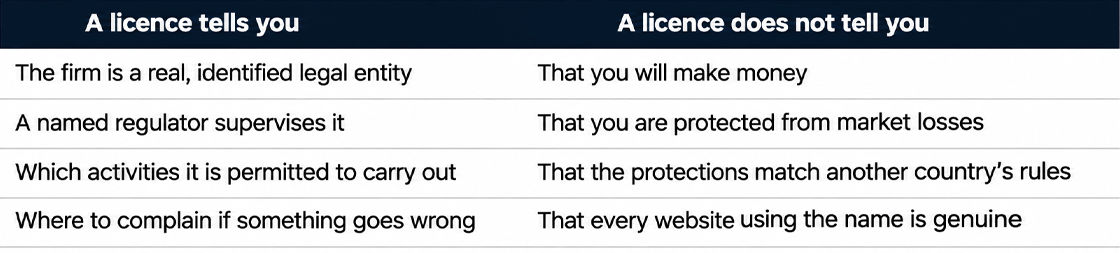
Rules differ from one regulator to another, for example on how client money is held, the maximum leverage allowed, reporting, and how complaints and disputes are handled. Once you know which regulator covers your account, read its own guidance on the protections that apply. Costs are a separate question; our guide to spreads, swaps and fees explains what to compare once a broker has passed this check.
Red flags that end the check early
No licence number, or a number that does not appear on the register
A name that differs slightly from the register entry, or a domain the register does not list
A "regulator" you cannot find among recognised authorities
any warning or alert about the firm or its website
requests to deposit to a personal bank account or a private crypto wallet
Unsolicited contact on WhatsApp or social media, promises of fixed returns, or pressure to deposit quickly
If you have more than ten minutes
Company registry: search the company registers in the firm's home country to confirm the entity exists and when it was incorporated.
Domain age: a public lookup such as ICANN Lookup shows when a website was registered. A domain created a few weeks ago for a firm that claims years of history is a warning sign.
Ask the regulator: most regulators will confirm whether a firm is authorised if you contact them directly.
Check the platform: on a demo account in MetaTrader 5, the server name shown at login normally carries the broker's name. Check that it matches the firm you verified.
After the check: five questions to ask before you deposit
A broker that passes the ten-minute check is who it says it is. That does not yet tell you whether its terms suit you. Before you deposit, put these five questions to the broker in writing, and compare the answers with the client agreement:
Where is client money held? Ask whether client funds are kept in segregated accounts, separate from the company's own money, and with which banks.
How do withdrawals work? Ask how long they normally take, whether any fees apply, and confirm that funds are returned to the original payment method in your name.
What will trading actually cost? Ask for typical spreads on the instruments you plan to trade, overnight swap rates, and any account or inactivity fees.
What leverage, margin call, and stop-out levels apply? These decide how much margin a position needs and how quickly a losing position is closed.
How do I raise a complaint? Ask for the complaints procedure and which body handles disputes if the broker cannot resolve one.
A well-run broker answers all five clearly and points you to the document where each answer is written down. Vague answers, or pressure to deposit before you receive them, are a reason to walk away. You can put these questions to us at any time through the contact desk, and the Accounts page sets out the conditions for each account.
Knowing how to verify a forex broker takes about ten minutes, and it is the one check you only need to do once per firm. Repeat it whenever a broker's details change, when a new "account manager" contacts you, or before you recommend a broker to someone else.